Tuesday, 25 February 2014

TRX a boon for 1MDB but a bane for property owners

THE EDGE WEEKLY ISSUE#1002
THE WEEK OF FEBRUARY 17 – 23, 2014
By: CHARLES YONG

Notwithstanding the challenging financials of its power plants investment, 1Malaysia Development Bhd (IMDB) looks set to book yet another huge gain from its flagship Tun Razak Exchange (TRX) development.

The 70 acres of prime land in Jalan Tun Razak, which was bought cheaply from the government and re-valued several times to produce what some call “paper profits”, may again be re-valued to beef up the sovereign wealth fund’s debt-laden accounts.

One of the most sizeable developments to take shape in modern KL, TRX nestles in the central business district, less than 10 minutes’ deive from the Petronas Twin Towers.  Tracts in the vicinity have recently sold for as high as RM3,325 psf.

Eager for similar returns, 1MDB priced its TRX land at RM3,000 to RM3,500 psf in its recent call for tenders for the initial portion of the land, says Foo Gee Jen, managing director of C H Williams Talhar & Wong (WTW), one of two real estate advisers marketing the initial phase of the project.

The price for a specific plot depends on factors such as size and plot ratio.

“The average size (for the TRX land tendered out) is 1.25 to 1.5 acres, and the plot ratio range from six to 10.5,” Foo tells The Edge.

According to him, the net developable area for the entire 70 acres in TRX is between 50% and 65%.

Thus, based on the current land price of RM3,000 to RM3,500 psf, a back-of-the-envelope calculation yields an indicative market value for the saleable portion of the TRX land at between RM4.57 billion and 6.94 billion.

This is RM2.79 billion (157%) to RM5.16 billion (290%) higher than the RM1.78 billion recorded in 1MDB’s books as at March 31, 2012.

These estimates are likely to undershoot the value that TRX could eventually rise to.

Barring a major softening in the property market, prices are bound to increase further for future stages of development.  Bear in mind that the TRX has a development period of 15 to 20 years, and the call for joint venture partners and buyers last December is only for the first stage, comprising a total of six acres.

Stage 1 consists of four plots of land (out of 34 plots), says Foo.

This initial phase includes four office towers (including a signature tower), up to five residential towers, up to two five-star hotels, and a retail mall.  The whole district has an indicative (GDV) of RM26 billion.

1MDB has said that it plans to continue holding equity interests through joint ventures for the majority of TRX’s developments.  This means even higher profits in the long run.

Such a significant revaluation may prove a boon to the company, which has been engulfed in debt and controversy.  As at March 31, 2012, 1MDB had RM8.38 billion in liabilities.  But the gearing ratio is much higher today as it has racked up at least RM22.69 billion in new debt since 2012 to finance its power business and other investments.

Power is not the only contentious investment made by 1MDB.  To generate income, the sovereign wealth fund lent US$1.5 billion of its own borrowings to PetroSaudi International Ltd, a privately owned oil company, through two bullet bonds expiring in 2015 and 2021 with interest rates northwards of 8% (see timeline).

The “profit rate” from these Islamic instruments provided RM331.58 million of its RM938.42 million income in 2011.  TRX’s revaluation made up the rest.

Opposition leaders claim that 1MDB has provided few details on the investment and on PetroSaudi, and that the loans put public money at risk.

1MDB has re-valued TRX at least twice.  It bought the 70 acres from the government for a mere RM320 million (RM105 psf), according to media reports.  In 2011, it re-valued the land to add RM826.6 millin to its income and rescue itself from the red.

By 2012, the land was re-valued again, to RM1.78 billion.  Under conventional practice, says an accountant, it is unusual for developers to re-value their land held for development regularly.  It is also uncommon for them to record the gains in their income statement.

At such high prices for TRX’s land, the question is, will there be enough buyers?  After all, only two recent transactions have reached such record prices: Singapore’s Oxley Holdings’ purchase of a 3.1-acre parcel in Jalan Ampang last November at RM3,325 psf and KSK Group Bhd’s acquisition of a 3.95-acre tract near Jalan Conlay last December at RM3,299 psf.

However, Foo says that demand has been “very encouraging” and that there are reasons to expect TRX to attract buyers.

Oxley acquired the Jalan Ampang plot before securing the approvals for development.  The TRX plots, on the other hand, come not only with approvals, but with wide-ranging incentives such as tax breaks, allowances, cost deductions and stamp duty exemptions.

These include a 50% deduction on rental payments for 10 years, further deduction on relocation costs, an industrial building allowance worth 10% of qualifying building expenditure, and an exemption of 70% of statutory income derived from the disposal of buildings and from five years of rental.

Foo adds that TRX is also attractive because it is an integrated development rather than a standalone one.  “And the price is also on a net basis.  This means that developers do not have to allocate any portion of the land they paid for to infrastructure.”  He estimates that the Oxley land, on the other hand, has a land loss of (15-20 %).

Because of these special incentives and treatment for TRX, local developers have voiced concerns that the state-backed megaproject would sponge off demand for offices from surrounding area.

“The whole thing is totally unfair because incentives are normally given to attract investors to green field developments that are away from established regions, like in Iskandar, but TRX is right in the KL city centre next to established business districts,” says one property developer.  “It is not right that 1MDB should enjoy this special treatment even if it is government-owned.”

Observers say that TRX is a clear example of the government crimping the private sector, a move which is contrary to its goal of letting the private sector drive the economy.

Bandar Malaysia, the other property project in 1MDB’s pipeline, also seems promising.  It has a GDV of RM20 billion and sits on 495 acres of the current military airport in Sungai Besi.

It was reported that 1MDB has acquired the site from the government for about RM1 billion, translating into RM46.40 psf.

However, 1MDB is also bearing the cost of relocating the military airport for RM2.1 billion, which indicates that the total cost for the 495 acres is RM3.1 billion.  The development of Bandar Malaysia may take some time though, at least until after the current military airport is relocated.

Given the cheap land cost and their strategic locations, observers say TRX and Bandar Malaysia will be the real money spinner for 1MDB, compared to its debt-laden power assets investments that give little room for manoeuvring.

It is, therefore, hard not to view TRX and Bandar Malaysia, which were given to 1MDB on a silver platter, as anything but a backstop for its blunders elsewhere.

However, the collateral damage to the rest of the property sector of (KL) could be heavy. 


Monday, 24 February 2014

MyHome grant to boost medium-low-cost segment, says housing minister

THE EDGE WEEKLY ISSUE#1002
THE WEEK OF FEBRUARY 17 – 23, 2014
By: LAM JIAN WYN

The proposed annual RM300 million MyHome grant is to encourage developers to build medium-low-cost homes but sell them at low-cost prices to eligible buyers, says Minister of Urban Wellbeing, Housing and Local Government (UWHLG) Datuk Abdul Rahman Dahlan.

“We want to encourage more developers to go into mudium-low-cost segment.  They get some margin from this segment, but there aren’t enough of them building these homes.  So we want to incentivise it, so that more people build these homes and everyone will buy them,” he tells The Edge.

“It also solves the problem of these buyers finding the money to pay a down payment and reducing the cost for developers,” he adds.

Abdul Rahman explains that this move will encourage developers to sell low-medium-cost homes at the price of low-cost homes, or build low-cost homes of a better quality.

“What we are proposing is an improvement over the lowest common denominator, which is low-cost homes.  So let’s say you are a developer and you want to start your low-cost project this year and plan to sell each home at RM70,000 instead of RM40,000 …… that subsidy gives you some breathing room,” he says.

He stresses that this low-cost programme will apply to private developers with project over 10 acres, whereby low-cost homes will have to make up as much as 20% of the project.

According to (PM Najib) earlier this week, up to RM30,000 will be granted to 10,000 eligible buyers of low-cost homes developed by the private sector.

According to the Ministry of (UWHLG)’s policy and planning division, (KL)’s low-cost homes were priced at up to RM42,000 while new launches are priced up to RM63,000.  Meanwhile, medium-low-cost homes are priced from RM42,001 to RM150,000, with new launches priced from RM63,001 to RM100,000.  Low-cost homes in Selangor are priced at under RM42,000.

To qualify for the MyHome subsidy, interested developers must first register their projects under the housing ministry, which then evaluates them to determine if they are eligible.  After that, buyers must register with the ministry to be able to buy these homes.  Potential buyers must earn below RM3,000 per month, not own ay properties, and be economically-disadvantaged.  Homebuyers are not allowed to sell their units for 10 years.  “We have not figured out a buyback mechanism for owners who wish to sell their units before the 10 years is up, but I will bring it up in the next National Housing Council (NHC) meeting.”

For now, the RM300 million will sit in a trust fund.  “The (PM) is committed to giving my ministry RM300 million a year, and I am committed to managing the funds well.  I think this is the best way to get low-cost housing to the public because if we do it through the PPR (Program Perumahan Rakyat or People’s Housing Programme), the cost is huge.  So, instead of paying RM100,000 per unit, I am only paying up to RM30,000 per unit.”

While Real Estaes and Housing Developers Association (Rehda) president Datuk Seri Michael Yam aluds it as a step in the right direction, he says the grant will only help “narrow losses” incurred from low-cost projects.

“The cost of developing low-cost homes, excluding land cost, is already at least RM100 psf.  It these units are a minimum of 800 sf, that means the construction cost alone is at least RM80,000.  If you add land and infrastructure cost, it will go up much further,” he tells The Edge.

He adds that it should come from a wider tax base as housing is a social issue.  “The subsidy comes from the other taxpayers (who are buying free market properties) … they should be asking, why am I taxed again to help another brother when it should be general taxation like social welfare?  You should have a wider tax base as housing is a social issue.”

He also notes that in the meantime, government should use the funds more effectively.  “Why doesn’t the government, as a temporary measure, give 30,000 first-time homebuyers a grant of RM10,000 to stimulate the market?  It will have an immediate impact, as opposed to almost two years later (when the qualified low-cost projects take off).”

While the council had considered disbursing the RM300 million directly to eligible first-time homebuyers, Abdul Rahman says it may be unfair to those who had bought their homes earlier. E


Sunday, 23 February 2014

Sean Ng to redevelop Bangunan HL

THE EDGE WEEKLY ISSUE#1002
THE WEEK OF FEBRUARY 17 – 23, 2014
By: VASANTHA GANESAN

Datuk Sean Y T Ng of Mammoth Empire Group, known for the Empire Subang and Empire Damansara developments, is planning to convert yet another office building in Kuala Lumpur into a boutique hotel.

Ng, via Mammoth Empire Holding Sdn Bhd, is planning to redevelop Bangunan Hong Leong (later renamed Wisma Megah) at the corner of Jalan Tun HS Lee and Jalan Tun Tan Cheng Lock, into a 188-room boutique hotel that will include retail outlets, cinemas and recreational facilities.

It is understood that the building, which used to house a Hong Leong Bank branch and the Hong Leong Group’s corporate headquarters, was acquired by Mammoth Empire in April 2012 for an estimated RM38 million.

According to a submission to Dewan Bandaraya Kuala Lumpur (DBKL), Mammoth Empire plans to convert the office building into a hotel and make provisions for retail floors.  To accommodate the planned room inventory, it will add seven floors to the existing 16-storey building.

The company’s submission to DBKL specifies plans to convert the first and second floors into retail space while the sixth floor will house the cinemas.  The 188-room boutique hotel will be from floors 7 to 20 while the 21st floor is where the recreational facilities will be.

At the time of purchase, the asset had a total land area of 9,913.64 sf but after surrendering part of the land for a road reserve, the current land size stands at 9,504.61 sf.

It is understood that the initial application made on Dec 31, 2013, has been rejected by DBKL.  Nevertheless, a modified application can be resubmitted.

Should a similar application be approved, industry players estimate that the redevelopment could be to the tune of RM75 million, not including the possible reinforcement required on the foundations since more floors are to be added.

According to sources, the boutique hotel will be named Wolo, similar to the one in Jalan Bukit Bintang.  The later, which has 110 rooms, is located at the junction of Jalan Bukit Bintang and Jalan Sultan Ismail.  The building previously housed offices and was called Wisma KLIH.  In 2010, Ng’s wonderful Vantage Sdn Bhd bought the building for RM58 million from Equine Capital Bhd.

“The group plans to expand the Wolo chain,” says a source, adding that apart from the hotels in Bukit Bintang and Jalan Tun HS Lee, there will be another in Seremban, Negeri Sembilan.  The group may even change the name of the existing Empire Hotel in Empire Subang to Wolo, says the source.

The Wolo hotel chain charts its future expansion
In fact, the company’s website also hints at a Wolo hotel at Empire Remix in USJ, Subang Jaya.  Empire Remix is an integrated mixed-use development comprising lofts, business suites, a hotel and retail lots.

Incidentally, the Wolo houses Korean bakery Tous les Jours, for which Mammoth Empire holds the master franchise.  The Tous les Jours is owned by South Korea’s CJ Foodville, a member of CJ Group.

CJ Group also owns CJ CGV, the operator of a multiplex cinema chain in South Korea.  CJ CGV has 4DX technology – which arouses the five senses as the cinema will include effects such as wind, light, scent, motion and water.  “He (Ng) has always said he wants to start a cinema hotel,” the source says.  This suggests that the proposed hotel project in Jalan Tun HS Lee may incorporate such a cinema.

It is also rumoured that CJ CGV will be the anchor at the Empire City Damansara development.  Empire City, located opposite the Damansara Perdana township along the LDP, will be developed in three phases.  The first phase, with an estimated (GDV) of RM5 billion, will house offices, hotels, serviced apartments and a shopping complex.  It was reported that the second phase will include a theme park and a concert hall.

Last year, CJ Group teamed up with Iskandar Investment Bhd to develop a 9.5ha site in Iskandar Malaysia, Johor.  The project, with an estimated GDV of RM4 billion, will include office towers, hotels, serviced apartments, loft offices, retail lots, a convention centre, concert hall and cinema.

Construction of the project, called Medini Empire, is expected to commence in 2015 and will be completed in 2018.

One of the first known projects by Mammoth Empire is its development in Subang.  It owns and operates Empire Shopping Gallery and the Empire Hotel.  It has since completed a couple of projects in Bangsar, including The Ara and The Loft.

Mammoth Empire is also involved in developments in mebourne, Australia. Reports say that apart from the A$250 million, 55-storey MY80 development, the group plans to build twin towers to complement MY80. E


Friday, 21 February 2014

Land swap deal to make TSR a major developer

THE EDGE WEEKLY ISSUE#1001
THE WEEK OF FEBRUARY 10 – 16, 2014
By: JANICE MELISSA THEAN

A land swap deal with the government to relocate the Royal Malaysian Air Force (RMAF) base in Butterworth could seal TSR Capital Bhd’s status as a major property developer when it gets more than 1,000 acres of prime land.

TSR, a joint venture (JV) with Lembaga Tabung Angkatan Tentera (LTAT) and Pembinaan Bukit Timah Sdn Bhd (PBT), will be given 1,007 acres – existing airbase in Teluk Air Tawar, Seberang Prai – in return for building a new RMAF base at a location yet to be determined.

The parcel has been slated for an integrated mixed-use project with a potential (GDV) of more than RM10 billion, TSR said in its announcement to Bursa Malaysia last Wednesday.

“This development will take us at least 10 years (to complete),” TSR group accountant Ng Kim Keong tells The Edge.

“We will start planning the mixed-use development about two years after signing the agreement with the government,” he says, adding that the relocation of the airbase will be done first.

The proposed deal, which is now in the negotiation stage, is due to be signed a year from now.

Last Wednesday, TSR announced that it has received the government’s approval in principle to set up the JV company to enter into negotiation with the latter to redevelop the RMAF base.

TSR will have a 51% stake in the JV, while LTAT and PBT will hold remaining 30% and 19% respectively. 

“We need to buy new land in Penang (to relocate the airbase),” says Ng.

He adds that the new airbase is estimated to cost RM3 billion, including land cost.  “But it could be cheaper as we are looking for land further from town.”  The existing airbase is sitting on seafront land, directly opposite Penang island and 8km away from Butterworth.

It is still early days and , thus, the valuation for the 1,007 acres has not yet been determined.  As this parcel is payment from the government to relocate and build the new RMAF base, theoretically its value should match the estimated cost of the airbase.

“The land may not be worth RM3 billion, so the government will have to provide more if it falls short.  In the same way, there may be an excess if the construction cost is less than the value of the land, and we will have to return that to the government,” says Ng.

The JV partners have yet to work out the financing structure for the construction of the new airbase, but he says the aim is to have a 90:10 debt-equity ratio.  At most, 80% will be debt-financed.

The partners will have to fork out the equity portion according to their respective stakes in the venture. 

“We have broken it down into six phases, so each phase will cost roughly RM500 million.  It will take us four to five years from the signing of the agreement to complete the new airbase,” says Ng.

TSR’s growing property portfolio
“In future, our focus will be more on property development.”  At present, the construction and property development segments contribute equally to TSR’s revenue.

While the 10-year project TSR has envisioned for the Butterworth tract is still some time away, it is expected to add significantly to the group’s GDV pipeline.

TSR says the tract will be redeveloped into a “city of arts, culture and leisure that promotes an eco-sustainable and modern lifestyle”.

“For the next six years at least, we expect to launch GDV of RM100 million to RM150 million each year,” Ng says.
TSR’s flagship development is the 70-acre PD Waterfront in Port Dickson, Negeri Sembilan.  Phase One, with a GDV of RM130 million and from which TSR gets rent income, is completed.

It launched Phase Two, comprising service apartments worth some RM120 million, last September.  “This year, we will launch another serviced apartment project with a GDV of RM150 million,” says Ng.

The total GDV of PD Waterfront is expected to be about RM2.2 billion and TSR will take another eight years to complete the project.

“We are also finalising other land developments in Bandar Enstek, Negeri Sembilan,” he says.

The group has submitted its development order (DO) application for a mixed-use development on a 20-acre tract.  The project, with a GDV of RM400 million, is expected to be carried out in three phases.

TSR has also made DO submissions to build a RM100 million office block in Jalan Semantan, Kuala Lumpur.  “We should be able to launch this by the end of this year,” Ng says.

Based on these projects, TSR could have a potential GDV of more than RM12 billion over the next decade (see table).

Its construction division has an order book of some RM400 million, which will last another three to four years, according to Ng.  This includes the two (MRT) jobs, worth RM330 million, awarded in 2012.  He says the packages are 30% completed currently.

TSR’s market capitalisation stood at RM148.4 million as at last Thursday’s closing.  Its share price moved up 10 sen, or 7.62%, to RM1.43 the day it announced the RMAF land swap, a high not seen since 2007.  Year to date, it has risen 15% before retreating to close at RM1.31 last Thursday.

As at end-September 2013, TSR had net assets per share of RM1.10.

For that quarter, TSR posted a net profit of RM251,000, flat from the RM223,000 in 2012.  This is on the back of 35.03 million in revenue, up from the preceding year’s RM26.4 million.

Net profit amounted to RM1.1 million for the nine months ended Sept 30, 2013, compared with RM1.33 million the year before.  Revenue for period came in at RM77.05 million, higher than 2012’s RM65.83 million. E


Thursday, 20 February 2014

Takashimaya eyeing Malaysia?

THE EDGE WEEKLY ISSUE#1001
THE WEEK OF FEBRUARY 10 – 16, 2014
By: VASANTHA GANESAN

Renowned Japanese department store operator Takashimaya Co Ltd may be making its way to Malaysian shores.  The retailer is believed to be scouting for a suitable location in the country and may have even set its sights on having a presence at the Tun Razak Exchange (TRX) in Kuala Lumpur (KL).

According to sources, Takashimaya has been interested in the Malaysian market for several years but it was only recently that it became more aggressive in surveying the market in search of a right location.

Top-level management of Takashimaya Singapore Ltd, a unit of the retailer, made several visits to Malaysia last year to gather information on the retail scene.  “They were here to look at locations, economy, spending power, possible positioning and potential target market,” a source tells The Edge.

Malaysia, which is fast becoming an international shopping haven, is set to record retail sales to the tune of RM98 billion this year.

It is learnt that Takashimaya conducted night surveys on the Malaysian market last year.  Night surveys are done by collecting occupancy data on number of lights that are switched on at the high-rise residences and office towers within an area.  They are said to give an indication of whether the buildings are occupied or are left empty by the investors.

The Edge understands that should Takashimaya enter the Malaysian market, it will be through its Singapore subsidiary.  The Singapore store opened in 1993.  Many Malaysians are most familiar with Takashimaya’s store in Ngee Ann City in Orchard Road, but the retailer also operates in France, Taiwan and China.

A media officer at the advertising and promotions department of Takashimaya Singapore, when contacted by The Edge, says his department cannot disclose anything on the matter.  He advised The Edge to speak to the general manager.  The office of the general manager, however, says it has no authority to comment on it.

Previous news reports stated that Takashimaya was contemplating opening a store in Malaysia and Indonesia and its strategy was to operate eight stores in Asia within five years from 2013.  It now operates three stores in Asia – Taiwan, China and Singapore – and is scheduled to open an outlet in Vietnam next year.

Another source tells The Edge that Takashimaya is eyeing an opening at TRX, the up-coming international financial district in (KL).  Sitting on 28.35ha o freehold land, TRX is expected to have world-class residential, retail, leisure and cultural offerings.  The project will be developed over 15-20 year-period.

In December 2013, master developer, IMDB Real Estate Sdn. Bhd. invited international and domestic investors to submit proposals for Stage 1 of TRX.  Stage 1 comprises four office towers, including a signature tower, up to five residential towers, up to two five-star hotels and a retail mall.  This phase is slated for completion in 2017.

TRX offers incentives to partners and investors such as income tax exemption of 70% for five years for building development while tenant incentives include a 10-year tax deduction for rents or building purchase, stamp duty exemption for initial leasing or purchase of a building and tax deduction for relocation costs.

CBRE is the marketing consultant for the initial market sutudy and the sale / joint-venture for the lifestyle parcel, which includes commercial, retail, hotel and residences.  CBRE managing director Allan Soo, when asked if Takashimaya is planning a store at TRX, declined to comment.

Takashimaya Singapore has been used by the group to venture into another Southeast Asian country – Vietnam.  Two years ago, the group announced that it will be opening a store in Saigon Centre in Ho Chi Minh City in 2015 and will be the anchor tenant.

Takashimaya’s origin dates back to 1831 when its first shop selling kimonos opened in Kyoto, Japan.  Nine years later, it expanded throughout Japan.  Today, it operates 20 modern department stores in Japan.

The possible entry of Takashimaya follows news of yet another department store operator which has Malaysia on it radar.  The Edge recently reported that France’s Galeries Lafayette has also made visits to the country with plans to open here.

Other Japan-based department store operators in Malaysia include Isetan and Aeon.  Recently, several Japan-based speciality stores, such as Uniqlo, Daiso and 100 Yen Shop, were seen building their networks in the country.E


Wednesday, 19 February 2014

Household stress emerging

THE EDGE WEEKLY ISSUE#1001
THE WEEK OF FEBRUARY 10 – 16, 2014
THE STATE OF THE NATION
A WEEKLY UPDATE

Are Malaysian households beginning to feel the pinch?
Last week, we published a special report entitled “The State of the Nation”.  It addressed various issues about the economy, the stock market and politics today that you need to know.

Using the horse as an analogy, given that this is the year of the Wooden Horse in the lunar calendar, The Edge argued that for Malaysia, it is not a wooden, but WOUNDED horse.

The horse was overstretched in the last few years, galloping after being fed financial steroids.  The fiscal indiscipline and consumption spree of the last few years were facilitated by a massive injection of cheap global liquidity and an enormous growth in domestic bank loans to consumers.

The steroids are now being gradually withdrawn.  Liquidity is moving out of emerging markets and interest rates are set to rise globally.  Chart 1 shows the performance of major world stock markets since the start of the Year of the Horse.  Clearly, the horse is not galloping.  Whether this is due to poorer-than-expected manufacturing data from the US and China or the strengthening of the yen is secondary.  The point is that the world is in a period of uncertainty.

The stock markets did not only fall over the last few trading days, but more significantly, they all saw single-day plunges.

Japan’s Nikkei 225 and Hong Kong’s Hang Seng Index plummeted 4.18% and 2.89% respectively on Feb 4 while the Dow Jones Industrial Average tumbled 2.61% on Feb 3.

In the coming months, The Edge will discuss various issues and attempt to provide insights, analyses and understanding.  In every issue of The Edge this year, The State of the Nation column will highlight recent developments by updating and analysing further the charts used in the original report.  This will help you keep track of the key variables to assist you in making informed business and investment decisions.

Real interest rates turn negative
Malaysian households are grappling with a rise in the cost of living and the effects are beginning to show, ahead of much bigger price hikes expected this year.

Today, we look at what the inflation numbers and, incidentally, Public Bank’s latest results tell us.  The worst is yet to come in terms of rising prices, yet we are already seeing negative real interest rates and stress emerging in some households.

Negative real interest rates arose after inflation outpaced deposit rates in Dec 2013.  This means inflation is eating the value of money in the bank.

The headline inflation rate in December 2013, as measured by the Consumer Price Index (CPI), rose to a more than two-year high of 3.2% from 2.94% a month earlier and just 1.25% in December 2012 (see Chart 2).  Bank Negara Malaysia (BNM) attributed this largely to the rising cost of food and non-alcoholic beverages.  It should be noted that the CPI is widely seen as understating the “true” inflation rate.

On the other hand, the average 12-month fixed deposit (FD) interest rate offered by banks has stagnated at 3.15% since Nov 2012.  (BNM) has kept the overnight policy rate at 3% since May 5 2011.

Based on the difference between the 12-month FD rate and the CPI, savers are now being punished with a negative real interest rate of 0.05%.  The gap becomes wider if we take into account savings with shorter tenures.  The average one-month and three-month FD rates are 2.91% and 2.97% respectively while tiered saving accounts typically yield less than 1%.

As highlighted in Chart 3, positive real interest rates have been declining over the years.  Low interest rates, combined with rising inflation and a flow of foreign funds into the region, helped asst prices rise in the past.

Interestingly, inflation has crept up even before the major price hikes expected this year.  A 14.9% average increase in electricity tariff took effect in January.  Housing, water, electricity, gas and other fuels alone constitute 22.6% of the total CPI weightage.

A higher electricity cost will have a cascading effect, raising the cost of virtually all goods and services.  As the government rolls back subsidies to trim the country’s budget deficit, the prices of essential goods and services are likely to continue rising.  Hence, inflation can only be expected to accelerate.

Will the central bank then raise interest rates to counter inflation?

The consensus is that there will be a 25bps to 50 bps rise in interest rates this year.  Already, emerging markets have started to raise rates in response to inflation, capital outflow and currency concerns.  However, local interest rates are not expected to rise much due to the high level of household and government debt.  That being the case, the trade-off could be a weaker ringgit.

Household stress affecting banks?
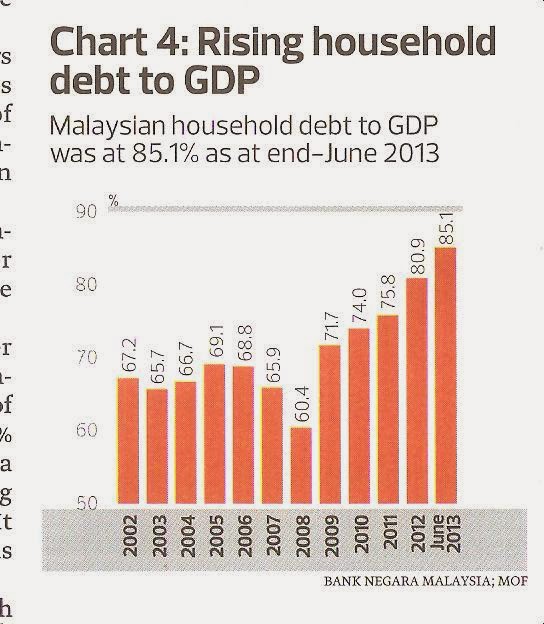
At 85.1%, Malaysia’s household debt-to-GDP ratio is the second highest in Asia.  As households become increasingly squeezed by high inflation and low wages, their ability to repay loans or borrow money comes into question.  For banks, this could mean higher non-performing loans and slowing loan growth ahead.

As banks start to announce their results for 2013, they will no doubt come under scrutiny for initial signs of household stress.  Nonetheless, any major impact on bank earnings will likely only emerge later in the year or in 2015 due to the lag in recognising non-performing loans and the disbursement of previously approved loans.

Public Bank released its results for 2013 last week, the first bank to do so.  Being Malaysia’s second largest lender and with 93.3% of its loans disbursed domestically, it can be seen as a bellwether in the domestic banking sector.  Well known for its high asset quality and prudent management, Public bank has the largest proportion of household loans among local players.

A quick look at its earnings shows commendable loan and profit growth in 2013.  Its domestic loans grew a robust 12%, gross impaired loans ratio (the key measure of asset quality) declined to 0.67% from 0.69% while net profit grew 6.2% to RM4.06 billion.

However, it also shows early signs of stress in the household sector.  Public Bank has very low levels of impaired loans, but the proportion of its household impaired loans compared with total impaired loans increased over the past year – from 63.1% to 70.8%.  This was despite its household loans being maintained at 63.8% of total loans over the last two years.

In 2013, Public Bank’s impaired household loans grew 21.1% outpacing the 11.8% growth in total household loans.  A quick calculation shows that the gross impaired loans ratio in its household portfolio increased from 0.69% in 2012 to 0.74% in 2013 despite an overall decline – from 0.69% to 0.67% -- in total loans.


To be fair, Public Bank’s impaired loan ratios are very low and should not be a concern to its shareholders.  However, they do imply that Malaysian households are starting to feel the pinch.                                                             E


Friday, 14 February 2014

Risk-based pricing to affect lending rates

THE EDGE WEEKLY ISSUE#1000
THE WEEK OF FEBRUARY 13 – JANUARY 19, 2014
By: BEN SHANE LIM

Depending on the borrower’s profile, banks’ rates for retail loans could change after March 17 when Bank Negara Malaysia (BNM)’s risk-informed pricing (RIP) policy is implemented.

The policy will ensure that banks adequately price in risks to their loans while pursuing a commercially-driven pricing strategy.  This comes at a time when the property sector has been hit with a slew of cooling measures and the automotive sector is expecting slower sales this year.

What will be the impact on borrowers?

Kenanga Research’s head of research Chan Ken Yew says risk-based pricing will benefit high-quality borrowers who could see lower rates while high-risk borrowers will have to pay higher rates.

“At present, banks are offering rates that are very much the same for most borrowers despite the fact that they may have different risk profiles.  This is because most banks take the portfolio approach and price their loans based on the overall average risk of borrowers.  Therefore, they are able to cover their credit costs because this is priced in to their average landing rate,” says Chan.

However, this means that borrowers with relatively good credit scores are subsidising those with higher risks, he says.  “Take, for example, two borrowers of equal financial standing each applying for a RM1 million loan to buy property.  One buys a single property with loan-to-value (LTV) ratio of 90% while the other purchases three properties.  However, because one can only borrow up to 70% LTV on the third property, the second borrower’s overall LTV is about 83%.  What we are seeing now is that they borrow at similar rates despite the fact that the first borrower has a gearing of 9 times compared with the second borrower’s 4.9 times,” explains Chan.

Ideally, the second borrower should get better rates than the first, and the RIP policy will encourage such lending practices.

Another example is that there is barely any spread between shorter loan tenures and longer ones, notes Chan.  “If you look at the bond market, interest rates are about 10 basis points higher for each extra year.  On that basis, a 15-year loan should be 1.5% cheaper than a 30-year loan, but that is not the case at the moment.”

There is some concern that there could be an increase in the average lending rate once the policy is implemented, given that lending rates have been trending down while house hold debts have risen to worryingly high levels.

Since 2007, household debts have climbed from 65.9% to GDP to more than 80% in 2013.  At the same time, BNM data shows that the average lending rate of commercial banks has gone from 6.6% to 4.56%.

Notably, with roughly RM300 billion in liquidity in the banking system, banks had to sell more loans to maintain their loan-to-deposit ratios.  On top of that, the property boom in the past few years fueled demand for housing loans, particularly with the highly popular developer interest bearing scheme.

Another area of concern is hire purchase loans that are at rock-bottom rates, considering that motor vehicles are assets with depreciating values.  According to one senior banker, AAA customers could secure rates as low as 2.3% while the average rate at the moment is around 2.4%.

AMMB Holdings Bhd group managing director Ashok Ramamurthy says AmBank is already practising risk-based pricing.

“It (the lending rate) depends on the profile of the customer.  We differentiate our pricing based on a whole range of characteristics.  So, the riskier the customer, the higher the price.  We’ve generally said that margins, after cost of funds, will be in excess of 200 basis points,” he says.

Nonetheless, in a written response to The Edge, BNM points out that the RIP policy is not a measure specifically intended to curb lending to households.  It emphasises that the decision to alter rates remains with the banks.

Instead, it’s meant to be a pre-emptive prudential measure to ensure that the financial service providers’ (FSPs) risk management practices are robust to face the increasingly intense competition in the retail loan segment, says the central bank.

“In managing risks, the policy requires the FSPs to look at pricing of all retail products and ensure that adequate information of the associated risks is taken into account in arriving at pricing decision,” it says.

Chan says from the banks’ perspective, it is hard to say what the impact will be at this stage as it will depend on a myriad of factors ranging from risk appetite to funding costs.  However, he points out that it should not have a negative impact on banks’ earnings as any change in rates will be offset by a corresponding adjustment to the banks’ credit costs.

“The risk-based pricing should not have a substantial impact on average lending rates.  I can’t speak for the other banks, but our bank has already been practising stringent risk management policies.  If anything, rising inflation and the likelihood of BNM raising the overnight policy rate (OPR) is more likely to result in a hike in interest rates going forward,” says one senior banker.

The OPR has remained unchanged at 3% since May 2011.

Meanwhile, inflation has crept up to 3.2% y-o-y in December, overtaking the OPR for the first time in two years.E